From: Pierce T. Wetter III: pierce@alumni.cco.caltech.edu
My only problem with using SGF is that it didn't seem to be a very natural representation for josekis and problem sets. You've had to add some conventions to allow it to provide answers (no doubt by using branches), but it would be nice to provide other information as well (problem goal for non life/death problems, score of games).
Comment MM: this should probably go into the style guide, e.g. how to present a problem without making the answer visible too early. Suggestions?
Should there be text formatting aids in text properties such as Comment?
jansteen:
Format conventions in Comment blocks
Currently there are no formatting laws at all in between the two brackets of a comment block. This is most annoying when preparing an article which has to be typeset later on. I would like to suggest a slightly more sophisticated scheme within a comment block. Maybe something like:
C[
    1. An empty line indicates a paragraph break. \\
    2. A newline indicates nothing. \\
    3. A line ending in "\\" indicates a line break.
]
Comment MM: This is a frequent complaint, so we should do something. Anders has proposed '\n' I think, but I cannot find his mail... Should all whitespace characters (e.g. tab) in a text be converted into spaces? Should '\r' characters be filtered out?
From: Anders Kierulf , Mar 8 1995:
Within comments, we should allow \n for New Line. Also, I think it should
be allowed to break comments (maybe all text properties) into shorter
pieces, e.g.:
        C[This is a very ]
        [long comment.]
Or even:
        C[This is a very ]
        C[long comment.]
This would make SGF files easier to send over email, and should
not be hard for SGF readers to implement.
Comment MM: The first alternative looks good. The second I do not like. Having the same property several times is discouraged by the style guide, and usually indicates an error. Why make an exception for Comments/Texts?
From: Antoine de Maricourt <dumesnil@etca.fr>, Feb 28, 1995
what about html like comments. They could be used for formating, or
more elaborated stuffs like 'click here to see solution' ... (cf
Pierce Wetter's remark above). We could also imagine some instruction
like 'playing at \var{2} is a bad move ...', that would expand into
'playing at D4 is a bad move' once formatted, if it turns out that the
variation 2 is at D4.
Not really easy to do :-)
Should there be comments that are shown for more than one position, e.g. for a whole variation? How could that be specified/implemented?
Comment MM: True. Any ideas?
From: Jan van der Steen <Jan.van.der.Steen@cwi.nl>
I think it's silly that:

        Bigbear == Buffalo == B

This doesn't make sense to me. For me, it's acceptable to have a
verbose mode and a short mode, but both should be well defined:

        Black == B
Comment MM: True. Should we do this?
From: Jan van der Steen <Jan.van.der.Steen@cwi.nl>
There is a lot of confusion about where the exact location of a variation should be, same level or after a move. I've entered a lot of games using mgt and for humans it's much easier and natural to enter the variation when commenting on the move you want to give an alternative for. So I *always* create the diagram after the move has been played and dully remove the originally played move. I understand the problems how to interpret the resulting tree but that's inherent to the format not to the user using the interface. Maybe we should reconsider the meaning of the braces.
        (
        C[Game start]
        ;B[point]
        ;W[point]
            (
            C[Subgame based on initial position with two stones]
            ;B[point]
            # ...
            )
        C[game continues]
        ;B[point]
        # ...
        )
So instead of splitting the main branche into two sub-branches
(which one is the game, and which is the variation?) we let the
main branche proceed untouched and just create a side branch
(subgame). No confusion possible, right?
Comment MM: Oh no! RTFM
Comment MM: it seems the HA (handicap) property, in conjunction with RU (rules), could handle both chinese and japanese style handicap.
From: Antoine de Maricourt <dumesnil@etca.fr>
I don't really understand the semantic of Dimmed points and Hidden points.
Comment MM: These new properties affect the display of the current position.
All points marked 'hidden' are not displayed, all 'dimmed' points are shown
greyed out. Compare the pictures below showing the same position
without and with dimmed and hidden properties.
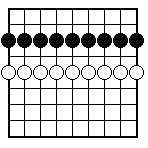
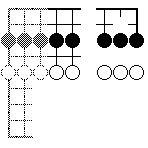
Here is the SGF file for the second picture, with HN and DD properties:
(;GM[1]SZ[9]FF[4]
AB[ac][bc][cc][dc][ec][fc][gc][hc][ic]
AW[ae][be][ce][de][ee][fe][ge][he][ie]
HN[fa][fb][fc][fd][fe][ff][fg][fh][fi][cg][dg][eg][gg]
[ef][df][cf][ch][dh][di][eh][ei][ci][hg][gi][ii][ih][ig]
[hi][gh][hh][if][hf][gf][gd][hd][id][hb]
DD[aa][ab][ac][ad][ae][af][ag][ah][ai][bi][bh][bg][bf]
[be][bd][bc][bb][ba][ca][cb][cc][cd][ce]
)
From: Antoine de Maricourt <dumesnil@etca.fr>, Feb 28, 1995
Why do you want to suppress the VieW ? I find it very convenient. I still like the idea that VW is a very convenient shortcut for a long long list of points. Moreover it could be used to give the bounding box of the visible points and use HD only to refine the shape of the visible part of the board. This would shorten the file's sizes.
What about more than 2 points for the view property, we could define one, two, ... boxes. Your example could be describes as : VW[aa][ee][af][bi][ga][ci][ge][gi]HN[hb]
Comment MM: Shall we keep it? It is not used in current Smart Go Board. The new 'hidden' property is a kind of replacement.
From: Antoine de Maricourt <dumesnil@etca.fr>, Feb 28, 1995
What about properties that could allow diagrams a la Berlekamp, i.e., display half a stone, quarter of stone ...? or small mark stones over other stones ?
Comment MM: Sounds good. A proposal, anyone?
From: Antoine de Maricourt <dumesnil@etca.fr>, Mar 6, 1995
Concerning Berlekamp's diagram. What about an extension of HN and DD.
We could have HN[ae] to hide the full point. To hide partial point we
could use HN[ae:04], where the first number references the starting
line (0 = north line, 1 = north-east line, 2 = east line, .. until 7),
and the second number the number of consecutive 1/8 of stone that
should be hiden starting from the reference line and going clockwise.
HN[ae:04] would hide the half right part of the stone. We could do the
same for DD.
From: Antoine de Maricourt <dumesnil@etca.fr>, Mar 8, 1995
The trouble with my proposition for hiden points is that it
will not allow to hide (or dim) more than one part of the stone.
What about HD[ae:192], where the number ranges from 0 to 255 and
every bit corresponds to 1/8th of the stone. If the bit is set, the
corresponding part of the stone is hidden.
Comment MM: Yes in principle. The encoding seems a bit abstract.
why not label the parts 1,2,3,..?
Then it could go like HD[aa][ab][ac:1234] to hide the first two points
completely, and 4/8 of the third point
From: Antoine de Maricourt <dumesnil@etca.fr>, Feb 28, 1995
Morevoer, I think we should emphasis on the node type (either a move, either a diagram). The Ishi format is well thought concerning this point. I still wonder what is the difference between : ;AE[cb]B[ec] and ;AE[cb]AB[ec] The second solution seems to be more coherent : the node is a diagram.
Comment MM: Hmm. Why do we need it? I'm happy with current state.
Reply Antoine:
Well, I just wondered what is the difference between ;AE[cb]B[ec] and
;AE[cb]AB[ec]. What about stones eventually captured by B[ec] ? Should
we remove them ? If no, why don't write AB[ec], for it has the same
meaning ? If yes, should B[ec] be played before AE[cb] or after ? I am
pretty sure I can build a diagram that will not be the same on two
given softwares.
Whatever are the answer to these questions, we could describe exactly the same diagram with only AE, AB and AW without trouble. My next argument is purely conceptual : I find it more regular (elegant ?) to have a type for each node, depending on the action that occured.
Also note that if we want to convert a SGF file to Ishi format, we must answer these questions and do the transformation I suggest.
Comment MM: Good points, need more discussion. Agree that B and W are special cases of AB and AW. The problem is what happens with illegal setups. Or if you capture stones with AB. Or setup an illegal repetition. etc. etc. I must check what SGB does, I'm not sure.
I will put it in style guide: do not mix moves and AddXX in the same node. Will this solve the conversion problem?
Reply Antoine:
We still have the answers the question of what to do with files that
does not respect the convention. Fortunately, the bad case is probably
rare, but who knows ...
Comment MM: A syntax and style checking program should be part of the spec. It could attempt to repair mildly damaged files. If this way we can clean the files on the servers, and all the writer programs, it would be a big step forwards.
Comment Antoine: This is a good idea. Yes. A really big step.
From: Anders Kierulf
I like the restriction that nodes cannot contain both AddBlack/White/Empty
and a move. If such nodes are read, they should be converted internally
into first a node with the Add... properties, followed by a node with the move.
Shall we allow a SZ (size) greater than 19? What limit?
From: Jan van der Steen <Jan.van.der.Steen@cwi.nl>
SGF needs a comment indicator, similar to "#" in the shell language, or "%" in PostScript and TeX. How about the "#" indicating comment till a newline is hit? It would make the above example syntactically correct.
Comment MM: Hmm. Why do we need it? I guess it will be lost when reading/writing a file.
When defining a standard it strikes me to read that unrecognised keywords should be quietly ignored. At least they should trigger a warning to the user they are being ignored I think. But furthermore when some application needs extra (environment specific) keywords but it's still sharing the syntax and the majority of keys with the SGF standard, is it still SGF format then? I don't think so. SGF should be the standard which can be used to exchange Go records without information loss.
Comment MM: agree, warnings would be useful for 'power users'. Might make it an option in SGB. SGF format is extensible by design, so a file with unknown properties is still a valid SGF file.
From: Jan van der Steen <Jan.van.der.Steen@cwi.nl>
It would be useful when SGF would force (allow) to emit the list of captured stones. It would allow much easier to write postprocessing software.
Comment MM: I have no real opinion on that. I don't need it. Make it a private extension??
Comment Antoine de Maricourt: Yes, it would be usefull. I don't need that either, because I compute captured stones, but I can imagine that less elaborated softwares would really appreciate to have the information on the hand.
From: Antoine de Maricourt
I think it would be usefull to have a way to write graphs instead of just trees. One possible solution is to do it like Common Lisp:
(
  ;B[move1]
  ;W[move2]
  (
    ;B[move4]
    ;W[move3]
    ;#1= B[move5]    <-  mark this node
    ...
  )
  (
    ;B[move3]
    ;W[move4]
    ;#1#           <- this is not a new node, but the one that
                      is marked with the same number.
  )
)
Comment MM: I like the idea, but would prefer to keep within current
syntax. I have something similar as Explorer private properties:
(
  ;B[move1]
  ;W[move2]
  (
    ;B[move4]
    ;W[move3]
    ;B[move5] UniqueMark[1]   <-  mark this node
    ...
  )
  (
    ;B[move3]
    ;W[move4]
    ;TransPosition[1]         <- this is a new node transposing into
                                 the one that is marked with the same number.
																 If you come here, you can jump to the other node.
  )
)
I keep the tree structure, so I have duplicate nodes. Somebody with
a general graph implementation could merge both into one node. Of course,
he/she must first define how to merge nodes.
Comment Antoine: Of course, your syntax is easier to insert in an existing parser.
From: Anders Kierulf
I think we should phase out the use of "tt" for Pass. What about using B[] and W[] for pass moves? That would get rid of the board size limitation to 19 (most programs would probably reject board sizes > 19, but at least the limitation would be in the program, not the file format).
From: Anders Kierulf
If we get rid of "tt", we can also allow usage of the standard Go notation for points (heresy!). I'm not sure whether this is still one of the sore points as to why some people don't like the format. As far as I know, there is really nothing in the format that prohibits us from doing that. A writer of SGF files could then choose whichever notation they prefer, and SGF readers just have to recognize whether the move is composed of two letters or a letter and one or two digits. (This would also work better with the proposal below for \'pp' in comments, since simple programs could just directly display the comment as is, and it would be human readable.)
From: Anders Kierulf
A triple property has three states: either it's not there, or it's simple, or it's double. If the property is in the file, I think it should be either simple or double. Thus I think X[], X[0], and X[1] should all be defined to map to X[1].
Comment MM: I think only X[1] and X[2] should be allowed in the spec. Others as indicated above should be caught by the syntax checker and be converted or deleted (after a warning).
From: Anders Kierulf
The PIB and PIW on IGS need to be replaced by two-letter codes, if they are necessary at all. Exactly how are they defined: if a move is illegal, how is the board changed when you play the move?
Comment MM: Can be replaced by KO property? Tim?